
Deadlines, Deliverables & Climate Action
Wetskills-SA Cape Town 2026 – Day 10 – Today was poster and paper submission day. We put the final touches on everything we’ve been building over the last few days.…

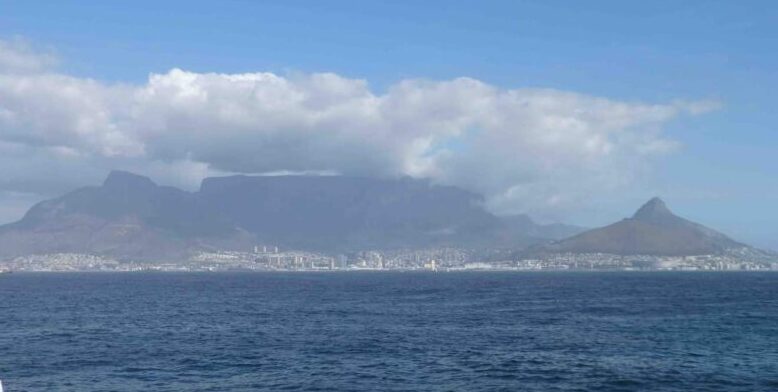

With this Event, Wetskills returned to South Africa, for the 12th time, for an inspiring new edition in Cape Town.
We have 25 participants, coming from South Africa, Lesohto and The Netherlands. They will join forces and work in 5 teams, to co-create innovative solutions for real-life water challenges. Set against the backdrop of one of Africa’s most dynamic water landscapes, this event will focus on practical, forward-looking approaches to strengthen partnerships, water security, resilience, and inclusive water management in Southern Africa.
The Finals and Award Ceremony will take place during the WISA Conference, South Africa’s leading sector event for water professionals. This offers participants a unique opportunity to present their solutions to a high-level audience of water utilities, policymakers, researchers, and industry leaders, and to connect directly with decision-makers shaping the future of the water sector.
Through intensive teamwork, mentorship, and collaboration with South African and international case owners, Wetskills-South Africa 2026 will once again demonstrate the power of young minds in shaping sustainable water solutions.
Participants of Wetskills-SA Cape Town, fieldvisit to the Water Hub at The University of Cape Town

Finals at the WISA Conference

Event Video of Wetskills-SA (Cape Town) 2026

A unique learning experience where you will tackle real-life water challenges with your own team!
More information
For additional information please contact Craig Tinashe Tanyanyiwa, craig.tinashe@wetskills.com or Johan Oost, johan.oost@wetskills.com.


Case owner: Rand Water
South Africa’s water sector is rapidly adopting digital technologies such as SCADA, smart sensors, automation, and data analytics to improve operational performance. How could technical education evolve at the same pace? Rand Water aims to develop a ‘National Digital Water Technical School’ that combines technical expertise with digital competencies through innovative curricula and partnerships. The model should be scalable, financially viable, inclusive, and aligned with national qualification frameworks while addressing both urban and rural water challenges, to strengthen workforce capacity. The team is challenged to develop a scalable National Digital Water Technical School, that prepares industry-ready professionals for a digitally enabled water sector.
Case owner: Water Research Commission
Close to half of the water supplied by municipalities is lost through leaks, theft, inaccurate metering, or poor system management (DWS No Drop Reports). This challenge calls on young innovators to explore how we can unlock a stronger social contract between government, citizens and private sector to turn around non-revenue water challenges. The goal is to identify the most powerful lever that will unlock a change in the way NRW is being managed, and design a financially viable and sustainable intervention that will support the turn-around of NRW.
Case owner: Dpt of Water and Sanitation
Roodeplaat Dam is a critical water resource for the city of Pretoria, but has long been affected by eutrophication, frequent cyanobacterial blooms, and excessive nutrient loading from upstream wastewater discharges. On the western shore of the reservoir, the Department of Water and Sanitation (DWS) operates the Roodeplaat Water Training Centre and the Resource Quality Information Services (RQIS) laboratories. Wastewater generated at these facilities is only partially treated, with treatment performance declining significantly during peak flow conditions. How can DWS design and integrate an artificial wetland, as a Nature Based Solution to protect this strategic water resource, and demonstrate this as a best practice for water stewardship?
Pitch & Poster

Pitch & Poster – winning team!
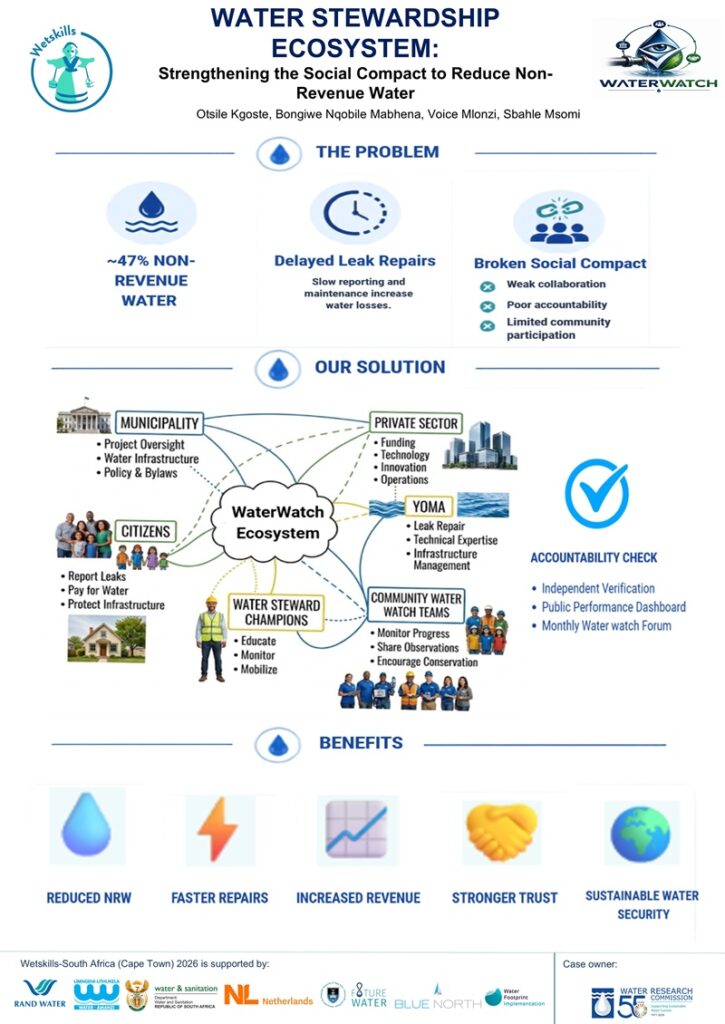
Pitch & Poster

Case owner: uMngeni-uThukela Water
uMngeni-uThukela Water (UUW) faces a severe challenge within the Albert Falls-Nagle-Durban Heights System (uMngeni River), which has experienced intense, ongoing algal blooms since mid-2024 due to widespread nutrient enrichment. Reversing this systemic eutrophication would require a strategic shift to complex quality management. To comply with the new SANS 241:2025 standards and the national Blue Drop audits, UUW must integrate advanced treatment technologies across all abstracting waterworks. How to balance the required capital and operational expenditure (such as surging chemical demands) with realistic funding models? This case challenges participants to design an innovative roadmap balancing high-tech infrastructure retrofits with affordable solutions, resulting in lifelong-safe water access in support of Sustainable Development Goal (SDG) 6.
Case owner: Water Footprint Implementation (WFI) and Blue North Sustainability
South Africa’s farmers and businesses face growing water risk, yet the value of water footprint accounting and reporting remains unclear to those who would need to act on it. Water Footprint Implementation and Blue North Sustainability have deep experience in South African agriculture to measure water footprints and support sustainability, but tangible benefits for individual farmers and decision-makers is still uncertain. This case invites participants to move beyond the technical methodology, and investigate the real-world incentives, barriers, and business logic that would make water footprint accounting genuinely useful – not just measurable – for South African farmers and companies.
Pitch & Poster

Pitch & Poster