Wetskills-Zimbabwe 2026 – Blog 3 –
Day three of the Wetskills program marked a decisive shift from theoretical orientation to practical exposure. Designed as a 360-degree immersion into Bulawayo’s water sector, the day wove together academic gathering, technical site inspection, and a deep dive into the cultural heritage that gives this region its enduring character.
1. Institutional Kick-off at NUST
The morning commenced at 09:30 at the National University of Science & Technology (NUST). Far more than a meeting point, NUST served as the academic backbone of the research we are undertaking this week. Conversations spilled out of lecture halls and into the courtyards as participants compared notes from the previous day’s sessions, sketched preliminary problem statements on notepads, and aligned on the questions they wanted answered in the field.
By the time the buses pulled up, the group had already self-organised into informal interest clusters — wastewater reuse, sanitation finance, climate resilience, and heritage-led tourism — a pattern that would shape the day’s discussions at every stop.
2. SAST Wastewater Treatment Works
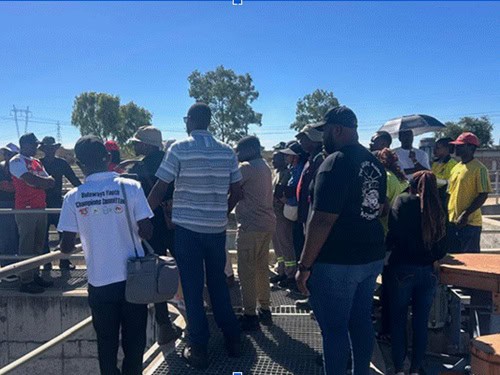
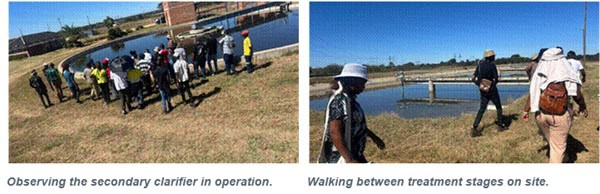
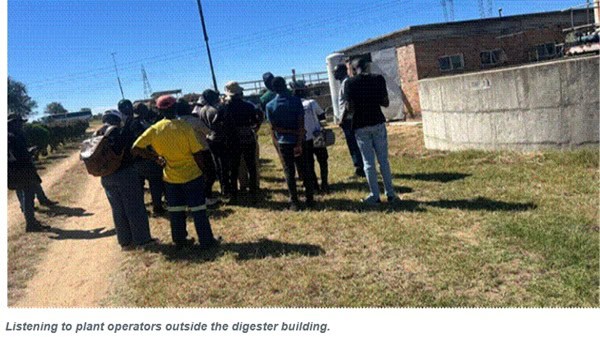
At 10:00, the cohort transitioned to the SAST Wastewater Treatment Works. This visit was instrumental in grounding our case studies in reality. Walking the perimeter of the aeration basins and clarifiers, we observed the operational flow of the facility — from inlet screening through biological treatment to final discharge — and began mapping the bottlenecks and opportunities embedded in Bulawayo’s water cycle.
Standing on the walkway above the clarifier, the abstract diagrams of our morning briefing suddenly had weight, smell, and motion.
Engineers on site walked us through the plant’s history: a facility built for a smaller, younger city, now serving a population whose demands have outpaced the original design envelope. We discussed the realities of intermittent power, ageing mechanical assets, and the constant balancing act between compliance and continuity of service. For the participants developing innovation pitches later this week, the visit reframed the brief: any proposed solution must survive the operational context we had just witnessed, not the idealised one in a textbook.
3. The Khami World Heritage Site
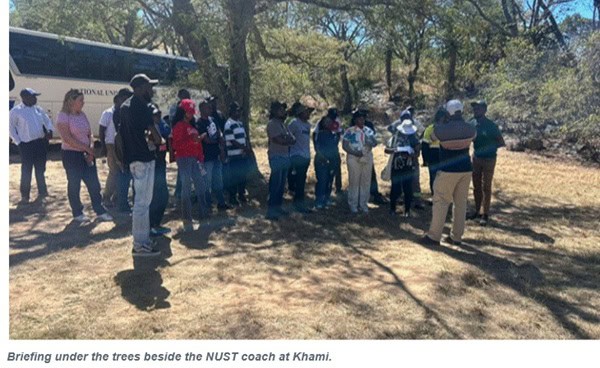
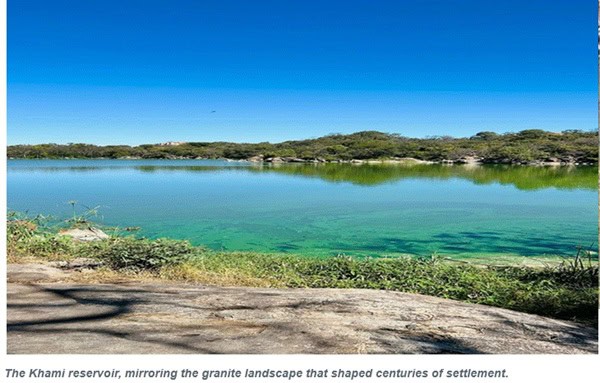
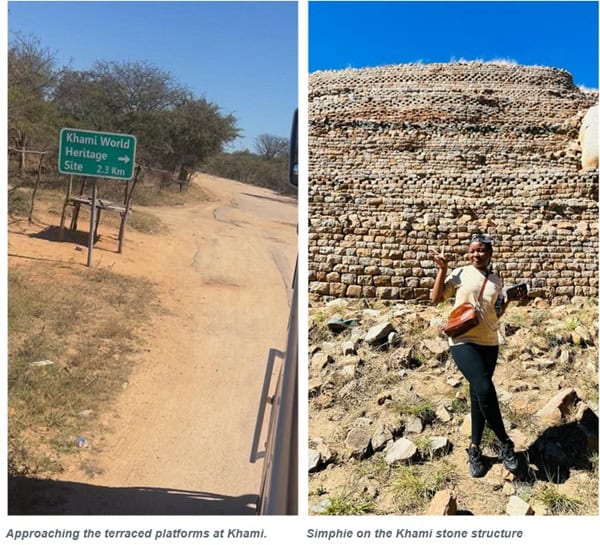
In the afternoon, the team travelled west of Bulawayo to the Khami Ruins – a UNESCO World Heritage site and the former capital of the Torwa state, which rose after the decline of Great Zimbabwe in the mid-fifteenth century.
The shift in tempo was immediate. Where the morning had been mechanical, metallic, and acoustically dense, the afternoon was open sky, dry grass, and the soft clatter of footsteps on weathered stone. Yet the underlying theme of the day – how people organise themselves around water – only sharpened.
Exploring the site offered a different lens on settlement and resource management. The intricate dry-stone walls, decorated with chequer and herringbone patterns, are the work of builders who understood drainage, terracing, and the long-term stewardship of a landscape. Standing on a platform above the Khami river valley, it was hard not to draw a line between the careful hydrology of the past and the engineered hydrology we had inspected just hours earlier.
Heritage is not a detour from infrastructure — it is the longest-running case study we have on what infrastructure is for.
Reflection: Where infrastructure meets memory
Day three did what the best field days do: it collapsed distance. The distance between a flow diagram and a clarifier. The distance between a UNESCO citation and a stone wall you can run your hand along. The distance between participants who, twelve hours earlier, had only just exchanged names.
As the cohort returned to Bulawayo at dusk, conversations on the bus had shifted from what did we see? to what do we do with it? — the exact pivot the Wetskills programme is designed to provoke. The pitches that emerge later this week will carry the fingerprints of both SAST and Khami: engineering grounded in operational reality, and ambition grounded in a much longer view of what it means to build something that lasts.