Wetskills-Tanzania 2026 – Blog 3 –
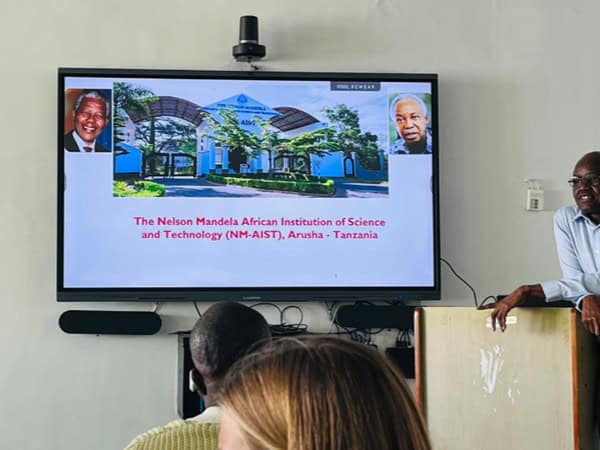
On Tuesday we visited the Nelson Mandela African Institution of Science and Technology (NM-AIST) in Arusha, Tanzania, as part of the Wetskills Tanzania 2026 programme. We were welcomed by Professor Hance, the Dean of the School of Materials, Energy, Water and Environmental Sciences, who introduced us to the institution’s multidisciplinary academic structure. He explained that the institution brings together four main areas: Life Sciences and Bioengineering; Materials, Energy, Water and Environmental Sciences; Business Studies and Humanities; and Computational and Communication Science.
The institution’s multidisciplinary academic structure highlighted the importance of interdisciplinary collaboration in addressing complex environmental and societal challenges.
Craig Tanyanyiwa introduced us to the Wetskills approach, emphasising creative thinking, collaboration and the development of practical solutions to water-related challenges.
Four cases were presented:
- mitigating saltwater intrusion caused by excessive groundwater pumping;
- integrating indigenous and local knowledge with Western science to strengthen food security under climate change;
- using historical crop water stress information for early warning;
- and improving water and sanitation service delivery through innovative business solutions.
During the BrainHurricane session, we engaged with four external experts, spending 10 minutes with each. These discussions allowed us to introduce our assigned cases, ask questions, gain expert insights and identify potential approaches to strengthening our proposed solutions. We also learned about WetsNext, an initiative that supports the further development of promising ideas into feasible projects with potential for implementation.
The programme also included training on action planning, cultural awareness and teamwork. We learned that effective collaboration requires mutual respect, active listening, open communication and an appreciation of different cultural backgrounds and perspectives.
Belbin’s team-role framework further demonstrated how recognising individual strengths and clearly assigning responsibilities can improve teamwork and ensure that tasks are completed effectively.